
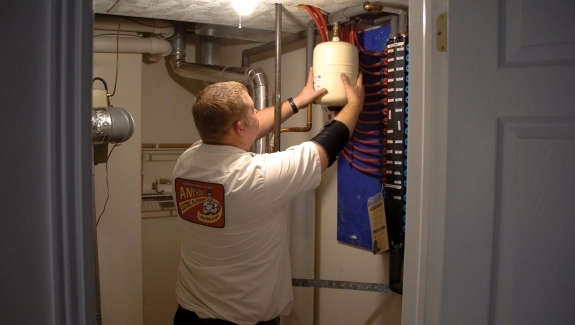
If you’ve ever peeked into your water heater closet, you might have noticed a small, often blue or white, tank sitting on top of the pipes like an oversized propane canister. This is a critical safety device known as an expansion tank.
In the desert heat of Phoenix, Arizona, our plumbing systems work hard. Between the high mineral content of our water and the modern “closed-loop” systems required by local building codes, your water heater is under constant pressure.
At Any Hour Electric, Plumbing, Heating & Air, we want you to understand how your home works. Let’s dive into the science of thermal expansion and why this small tank might be the only thing standing between you and a flooded garage.
What is a water heater expansion tank?
Think of an expansion tank as a shock absorber for your home’s plumbing. It is a small vessel designed to handle the extra volume of water created when your water heater does its job.
Inside the tank, there are two distinct sections:
- The Water Chamber: This connects directly to your plumbing.
- The Air Chamber: This is filled with compressed air and separated from the water by a flexible rubber diaphragm or bladder.
When water is heated, it expands. Because water can’t be compressed, it needs a place to go. The expansion tank provides that space. As the water volume increases, it pushes into the tank, compressing the air on the other side of the rubber bladder. This keeps your system’s pressure stable and prevents it from “redlining.”
Expansion Tanks
Click this link for a video explaining what that big metal bubble sticking out of your water heater is.
What is thermal expansion and why does it matter?
Thermal expansion is a basic law of physics: when you heat a liquid, the molecules move faster and take up more space. For every 10-degree rise in temperature, water expands significantly.
In an older “open” plumbing system, this extra water would simply push back out through your pipes and into the city’s water main. However, most modern homes in Phoenix use “closed” systems. These systems use check valves or pressure-reducing valves to keep your home’s water from flowing back into the municipal supply.
While these valves protect the city’s water quality, they trap the thermal expansion inside your house. Without an outlet, that expanding water creates a massive spike in pressure that can reach dangerous levels in minutes.
Why do I need an expansion tank in Phoenix, AZ?
Phoenix homeowners face unique challenges that make expansion tanks a necessity rather than a luxury.
- Closed-Loop Requirements: The Arizona Plumbing Code requires “thermal expansion control” in any closed-loop system. If you have a backflow preventer or a pressure regulator (PRV) on your main line, an expansion tank is likely required by law.
- Warranty Protection: Many major water heater manufacturers (like Rheem, Bradford White, and A.O. Smith) will void your warranty if the unit is installed in a closed system without an expansion tank.
- High Water Pressure: Phoenix municipal water pressure can fluctuate. Adding an expansion tank helps stabilize these spikes, protecting your pipes from “water hammer.”
What are the signs of a missing or failing expansion tank?
If you don’t have an expansion tank, or if yours has failed (usually due to a ruptured rubber bladder), your plumbing system will start showing symptoms of “high blood pressure.”
- The T&P Valve is Dripping: The Temperature and Pressure (T&P) relief valve on the side of your heater is a safety device. If it is constantly dripping or “weeping,” it means your system’s pressure is exceeding 150 PSI, and the valve is struggling to prevent a tank burst.
- Fluctuating Water Pressure: If you turn on a faucet and get a sudden “burst” of high pressure that quickly levels off, that’s a classic sign of trapped thermal expansion.
- Leaking Faucets or Toilets: High pressure wears out the seals and washers in your fixtures. If you find yourself constantly repairing leaky faucets or “ghost-flushing” toilets, your pressure may be too high.
- Banging Pipes: Also known as water hammer, loud thumping sounds when you turn off the water are often caused by the lack of an expansion buffer.
How long does a water heater expansion tank last?
Generally, an expansion tank has a lifespan of 5 to 10 years.
In Arizona, “hard water” (water with high mineral content) can cause the interior of the tank to corrode or the rubber diaphragm to become brittle and fail sooner. It’s a good idea to have a professional plumber from Any Hour check the air pressure in your tank once a year during your standard water heater flush and maintenance.
Your Water Pressure Explained
Click this link for a video discussing how high water pressure can destroy your plumbing and low water pressure can cause your pipes to clog.
What happens if I ignore my expansion tank?
Ignoring a failed or missing expansion tank is a gamble that rarely pays off. Over time, the constant “ballooning” and contracting of your water heater tank weakens the steel.
- Shortened Lifespan: A water heater that should last 10 years might fail in 5 because of the constant stress on the glass lining.
- Catastrophic Failure: In extreme cases, the inner tank can rupture, leading to a massive flood in your home or garage.
- Appliance Damage: High pressure isn’t just bad for the heater, it can ruin the solenoids in your dishwasher and washing machine, leading to expensive appliance repairs.
How does an expansion tank compare to a relief valve?
You might wonder why you need a tank if you already have a T&P relief valve. It’s important to distinguish between containment and relief.
- The Expansion Tank (Containment): This is a proactive tool. It saves the water and the pressure within the system, keeping everything balanced without wasting water.
- The Relief Valve (Relief): This is a reactive tool. It only works once the pressure has already reached dangerous levels. Relying on the T&P valve alone is like relying on the airbag in your car instead of using your brakes. It is a “one-time” safety measure that eventually fails if used daily.
Is it difficult to install an expansion tank?
While the tank itself is small, the installation requires precision. It must be installed on the cold water supply line, typically between the shut-off valve and the water heater.
A professional installation involves:
- Matching the Pressure: The air side of the tank must be pumped up to match your home’s static water pressure exactly. If the pressures don’t match, the tank won’t work.
- Proper Support: These tanks can become heavy if the bladder fails and they fill with water. They must be supported properly so they don’t snap the copper piping.
- Code Compliance: Ensuring the installation meets the specific Phoenix amendments to the International Plumbing Code.
Conclusion
A water heater expansion tank is a small investment that provides massive peace of mind. It protects your water heater, preserves your plumbing fixtures, and ensures your home stays up to code. Given the high stakes of water damage in a home, it’s one of the most cost-effective plumbing upgrades you can make.
If you aren’t sure if you have a closed system, or if your current expansion tank feels heavy or sounds “dull” when tapped, it’s time for a professional look.
Need an expansion tank installed or inspected? Contact Any Hour Electric, Plumbing, Heating & Air today to ensure your Phoenix home is safe and efficient!
Frequently Asked Questions (FAQ)
Q: Do I need an expansion tank if I have a tankless water heater?
A: Usually, no. Because tankless units do not store a large volume of water, there’s significantly less thermal expansion. However, if you have a “recirculation” system with your tankless unit, some local codes may still require one.
Q: Can I install an expansion tank myself?
A: It is not recommended. If the air pressure is not calibrated correctly to match your home’s PSI, the tank will be useless. Furthermore, improper installation can lead to leaks or pipe failure.
Q: How do I know if my expansion tank is broken?
A: Tap the top and bottom of the tank with a knuckle. One side should sound hollow (the air side) and the other should sound solid (the water side). If the whole tank sounds solid, the bladder has likely ruptured and the tank is “waterlogged.”
Q: Does every home in Phoenix need one?
A: If your home has a pressure-reducing valve (a bell-shaped device on your main water line) or a backflow preventer, then yes, you have a closed system and need an expansion tank.