
Choosing a new water heater is one of those essential home decisions that directly impacts your daily comfort and your monthly budget. In a place like Phoenix, Arizona, where the heat is legendary and hard water is a fact of life, this decision becomes even more critical. Homeowners often find themselves weighing two main contenders: the tried-and-true traditional storage tank water heater and the sleek, high-tech tankless (or on-demand) water heater.
This isn’t just about hot showers anymore; it’s about efficiency, cost, and reliability in a demanding desert environment. The right choice for your home depends on many factors, from your family’s size and consumption habits to the long-term energy savings you want to achieve. At Any Hour Electric, Plumbing, Heating & Air, we help our neighbors throughout Arizona navigate this choice every single day. We understand the unique challenges of living in the Valley of the Sun, and we’re here to bring you the facts, so you can make an informed decision.
We’ll explore the initial investment, the long-term operational costs, the energy efficiency ratings, and the specific considerations for hard water and high temps common in Phoenix homes. By the end of this guide, you’ll have a clear understanding of which water heating solution is the best fit for your needs and budget.
What’s the Main Difference Between Traditional and Tankless Water Heaters?
The fundamental difference between these two systems lies in how and when they heat water. Think of it as the difference between a reservoir and a river.
A traditional water heater acts like a reservoir.
- It has a large, insulated tank, typically holding between 30 and 80 gallons, where water is stored.
- It constantly heats the water inside the tank to a set temperature, regardless of whether you need it or not.
- When you turn on a hot water tap, the hot water is drawn from the top of the tank.
- Cold water then enters the tank to replace the used hot water, and the heating process starts again.
- This constant reheating, even when no one is home, leads to a phenomenon called standby heat loss, which accounts for a significant amount of wasted energy.
A tankless water heater, on the other hand, is the river.
- It’s a compact unit, usually mounted on a wall, that heats water only when it’s requested, hence the name “on-demand.”
- When you turn on the hot water, cold water travels through a heat exchanger inside the unit.
- A gas burner or electric element quickly heats the water to the desired temperature as it flows through the unit.
- When the tap is turned off, the unit stops heating, eliminating standby heat loss entirely.
- This system provides a nearly endless supply of hot water, a significant advantage for larger families.
The choice between a storage tank constantly reheating water and a tankless unit only firing up when needed is the core of the efficiency and cost debate. The function is the same, to provide hot water, but the different methods lead to vastly different long-term costs and experiences.
How Does the Initial Cost of Tankless and Traditional Heaters Compare?
When budgeting for a new water heater, you must consider both the unit’s purchase price and the installation complexity. The initial cost is typically where the traditional water heater shines, making it the more budget-friendly option upfront.
Traditional Water Heater Initial Cost Considerations:
- Unit Price: The physical tank unit is relatively inexpensive, with standard residential models typically costing between $500 and $1,500.
- Installation: Installation is generally straightforward, especially if you are replacing an existing tank with a similar model.
- Labor Costs: Installation usually involves simple plumbing connections and venting, resulting in lower labor costs, often ranging from $1,000 to $2,500.
- Overall: The traditional unit is the clear winner for homeowners focused solely on the lowest immediate expense.
Tankless Water Heater Initial Cost Considerations:
- Unit Price: The technology inside a tankless unit is more complex, leading to a higher purchase price, usually between $1,000 and $3,000 for a quality, whole-house unit.
- Installation Complexity: This is where the cost significantly increases. Tankless heaters often require upgrades to your home’s infrastructure, which is a key factor in many Phoenix properties.
- Gas Units: They may require a larger gas line and new, specialized venting (often stainless steel) because they need a higher BTU input than standard tank heaters.
- Electric Units: They may require a dedicated, high-amperage electrical circuit that your current wiring might not support.
- Labor Costs: Due to these potential infrastructure changes, the total installed cost for a tankless unit can range from $3,000 to $6,000 or more, depending on the extent of the necessary plumbing, gas, and electrical work.
While the initial price tag for a tankless system is substantially higher, it’s important to remember that this is an investment in long-term efficiency and lifespan. You are paying more upfront for a sophisticated system that will last longer and consume less energy over two decades.
Which Type of Water Heater is More Energy Efficient for a Phoenix Home?
Energy efficiency is the primary area where the tankless water heater offers a compelling long-term value proposition, especially in a region like Phoenix where utility bills are often high in summer months.
The Tankless Efficiency Advantage:
- Elimination of Standby Loss: The tankless unit only heats water on-demand. This means you are not paying to keep dozens of gallons of water hot 24/7.
- The U.S. Department of Energy (DOE) estimates that conventional storage water heaters can waste 15-20% of their energy just maintaining the water temperature.
- Energy Factor (EF) / Uniform Energy Factor (UEF): Modern tankless gas water heaters boast high UEF ratings, often in the range of 0.80 to 0.95. Traditional tank units typically range from 0.60 to 0.70. A higher UEF means more energy is converted into usable hot water.
- Potential Savings: For homes that use 41 gallons or less of hot water daily, a tankless water heater can be 24–34% more energy efficient than a conventional storage tank. Even for homes with high hot water demand (over 86 gallons a day), tankless models are still 8–14% more efficient.
The Phoenix Efficiency Context:
- Warmer Incoming Water: In Arizona, the temperature of the cold water entering your home is naturally much higher than in colder climates. This is a subtle but beneficial factor for both types of heaters. Since the heater doesn’t have to raise the water temperature as much, the energy cost to heat the water is lower overall compared to a Minnesota winter.
- Electric vs. Gas: Most high-efficiency tankless units in Phoenix are gas-powered, as gas is often cheaper per BTU than electricity in the region. Electric tankless units exist, but they require a tremendous amount of power to achieve high flow rates, making them less common for whole-house use in older Phoenix homes without major electrical upgrades.
While the energy savings are clear, the financial payoff is realized over many years. As a homeowner, you must calculate if the utility savings will eventually offset the higher initial installation cost. In a desert climate with high energy demands, many Phoenix residents find the long-term savings of a tankless system to be a wise investment.
What is the True Long-Term Cost of Ownership for Each System?
To determine the true cost of ownership, we need to look beyond the purchase and installation prices and factor in lifespan, operating costs, and maintenance. When the full lifecycle is considered, the script flips, and the tankless unit often proves to be the more economical choice.
Lifespan Comparison:
- A Traditional Water Heater has a shorter lifespan, typically 10 to 15 years, which is often reduced by hard water in Phoenix leading to corrosion.
- A Tankless Water Heater offers a much longer lifespan of 20+ years, provided it receives the necessary annual maintenance.
Operating Costs and Replacement Cycles:
- Traditional Cost: You pay a lower initial price, but you pay more every month in energy bills due to constant heating. Furthermore, you will likely purchase and install a replacement unit 1-2 times over a 20-year period.
- Tankless Cost: You pay a higher initial price, but you save on energy every month. Critically, you avoid the cost of mid-life replacement, as the tankless unit is designed to last the full two decades or more with routine care.
This difference in replacement frequency is the biggest differentiator in long-term cost. The initial higher investment in the tankless system essentially buys you a more durable, longer-lasting appliance that makes up the difference through energy savings and avoiding future replacement costs.
Maintenance Requirements:
- Traditional: Maintenance is generally low, but tanks are prone to rust and sediment buildup. Annual flushing is recommended to clear out mineral deposits and prolong the tank’s life.
- Tankless: Requires mandatory annual descaling/flushing to remove mineral buildup, especially with hard water in Phoenix. This service is essential to prevent scaling that restricts flow and damages the heat exchanger.
The longer lifespan and reduced energy consumption of the tankless system can easily overcome the higher initial investment, providing a better long-term return on investment (ROI).
How Does Hard Water in Phoenix Affect Both Water Heater Types?
Phoenix and the surrounding areas are notorious for having hard water, meaning the municipal water supply has a high concentration of dissolved minerals, primarily calcium and magnesium. This mineral content poses specific challenges for both water heater types, but in different ways.
Impact on Traditional Water Heaters:
- Sediment Buildup: Minerals settle at the bottom of the storage tank, turning into a hard sediment layer.
- Reduced Efficiency: This layer acts as an insulator between the heating element/burner and the water, forcing the unit to work harder and run longer to heat the water, significantly reducing its efficiency.
- Noise and Damage: The sediment can also cause popping or rumbling noises and can eventually pit and corrode the tank, leading to premature failure and leaks.
Impact on Tankless Water Heaters:
- Scaling: Because the water is heated quickly as it flows through a very small, high-heat transfer pipe (the heat exchanger), the minerals precipitate out of the water and “scale” onto the interior walls of the pipe.
- Flow Restriction: This scaling narrows the pipe’s diameter, reducing the flow rate and eventually triggering a shutdown code because the unit cannot heat the restricted water volume fast enough.
- Critical Maintenance: For a tankless unit in a hard water area like Phoenix, annual flushing (descaling) is not optional, it is mandatory preventative maintenance to maintain efficiency and prevent catastrophic failure.
Mitigation and Best Practices in Phoenix:
To ensure maximum lifespan and efficiency for any water heater in Phoenix, our experts at Any Hour recommend:
- For Traditional Units – Annual flushing to remove accumulated sediment.
- For Tankless Units – Dedicated annual descaling service to flush mineral buildup from the heat exchanger.
- For Both: Installation of a whole-house water softening system is the single best way to remove the minerals before they enter the heater, prolonging the life of all plumbing fixtures and appliances in your Phoenix home.
Does a Tankless Water Heater Provide Enough Hot Water for a Busy Household?
This is perhaps the most common question Phoenix homeowners ask, particularly those with large families, teenagers, or multiple bathrooms. The concern is flow rate: can a compact tankless unit keep up with simultaneous demand?
The Traditional Tank’s Capacity:
- A tank heater provides a finite capacity. If you have a 50-gallon tank, you get 50 gallons of hot water before you start experiencing a “cold shower” until the tank can recover and reheat the water.
- The reheat or recovery time can take up to an hour, leaving a large gap in hot water availability.
The Tankless Flow Rate Calculation:
- Tankless capacity is measured by Gallons Per Minute (GPM) of flow.
- The actual GPM is determined by the required Temperature Rise, which is the difference between the incoming cold water temperature and the desired output temperature (e.g., 120°F).
- In Phoenix, the warmer incoming water is a huge advantage. A tankless unit can produce a higher GPM in Phoenix than it could in a colder climate because it doesn’t have to raise the temperature as much, which makes sizing easier.
Matching the Unit to Your Home:
To ensure your tankless unit meets your needs, you need to calculate your peak demand, which is the maximum amount of hot water your family might use at one time.
- Typical Usage Rates: A standard shower head uses about 2.5 GPM; a kitchen faucet uses 1.0 – 2.0 GPM.
- Small Homes (1-2 bathrooms): A 6.0 GPM unit is often sufficient for one major appliance and one shower running simultaneously.
- Average Homes (2-3 bathrooms): A high-performance gas unit, often rated at 8.0 GPM to 10.0 GPM, is ideal for meeting high peak demand, such as running two showers and a dishwasher simultaneously without running out of hot water.
For a family in a larger Phoenix home, choosing a high-GPM tankless gas unit is essential. If the demand is extremely high, you may need a system with two smaller tankless units installed in parallel or a single, extra-large unit to ensure adequate service.
At Any Hour Electric, Plumbing, Heating & Air, we can perform a comprehensive hot water audit to calculate your peak demand and recommend the perfect GPM for your family’s needs.
How Do the Installation and Placement Options Differ in Phoenix?
The physical installation and required space are significant considerations, especially in densely built or older Phoenix neighborhoods where utility space might be limited.
Traditional Water Heater Installation:
- Space Required: The sheer size of the storage tank dictates where it can be placed. In Phoenix homes, they are commonly found in the garage or a dedicated utility closet.
- Floor Space: Requires a significant amount of floor space and needs clearance for maintenance and replacement.
- Venting: Gas tank models typically use a standard flue pipe, often vented through the roof.
Tankless Water Heater Installation:
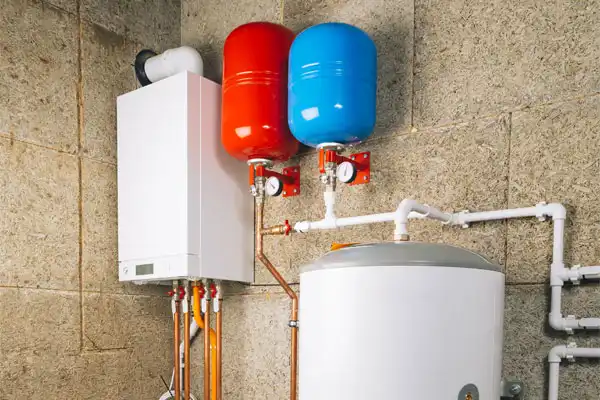
- Size and Location: This is one of the tankless unit’s biggest benefits. Its compact size, comparable to a carry-on suitcase, allows it to be mounted directly on a wall. It can free up valuable floor space in a garage or utility closet.
- Outdoor Installation: Many Phoenix homes opt to install them outdoors on an exterior wall, freeing up all indoor utility space. This is a popular option in our climate.
- Venting: Gas tankless units are often vented horizontally through a side wall with specialized, sealed PVC or stainless steel piping, which offers more flexibility in placement.
- Infrastructure Upgrades: The initial installation may require upgrading the gas line size or the electrical wiring to handle the unit’s significant power draw. This infrastructure work is a crucial, one-time investment that ensures safety and optimal performance.
For homeowners in Phoenix looking to reclaim space in their garage or utility area, the ability to mount a tankless unit on an exterior wall is a major selling point.
Conclusion: Making the Best Hot Water Decision for Your Phoenix Home
Choosing between a tankless and a traditional water heater requires balancing upfront cost against long-term savings, efficiency, and comfort. There is no single “best” answer, but there is a best answer for your specific Phoenix home.
The Traditional Water Heater is Best If:
- Your priority is the lowest upfront cost.
- Your home has low hot water usage or you live alone/as a couple.
- You are comfortable with a 10-15 year lifespan and a potential for standby energy loss.
The Tankless Water Heater is Best If:
- Your priority is maximum energy efficiency and long-term savings.
- You desire the luxury of an endless hot water supply for multiple users.
- You want a longer lifespan (20+ years) and are willing to commit to annual maintenance (flushing).
- You are looking to save valuable floor space in your utility area or garage.
The unique high summer temperatures of Phoenix, aid efficiency, but the severe hard water, mandates maintenance. A tankless unit offers a substantial energy saving advantage but requires a proactive maintenance plan to realize its full 20-year potential.
Whatever your decision, the installation, repair, and maintenance of your water heater is a job that should always be trusted to local, certified professionals, like Any Hour Services. The complexity of gas lines, electrical wiring, and hard water mitigation demands our expert knowledge.
Ready to stop worrying about cold showers and start saving on your monthly utility bills?
Don’t let water heater worries leave you in the cold or saddle you with unnecessary energy expenses. For expert guidance, professional installation, or any plumbing repair needs in the Phoenix area, trust the team that knows Arizona homes best. Contact Any Hour Electric, Plumbing, Heating & Air today for a consultation or to schedule your service!
Frequently Asked Questions About Water Heaters
1. Do tankless water heaters require special maintenance in a hard water area like Phoenix?
Yes, absolutely. Due to the high mineral content (hard water) common throughout the Phoenix area, tankless water heaters require mandatory annual maintenance called descaling or flushing. During this process, our professionals use a specialized pump and descaling solution to circulate through the heat exchanger, removing the mineral buildup (scale) that accumulates inside the pipes. Failure to perform this annual service will severely reduce your unit’s efficiency, restrict water flow, and drastically shorten its lifespan, potentially leading to a premature and costly replacement.
2. Can I run multiple showers at once with a tankless water heater?
Yes, you can, provided the unit is properly sized for your home. The ability to run multiple showers simultaneously depends on the unit’s Gallons Per Minute (GPM) rating. For an average Phoenix home with two to three bathrooms, a high-output gas tankless unit rated between 8.0 GPM and 10.0 GPM is generally required to run two showers and perhaps a dishwasher without a noticeable drop in temperature. Before installation, a professional plumber from Any Hour Electric, Plumbing, Heating & Air will calculate your home’s peak hot water demand to ensure the unit installed can comfortably handle your family’s needs.
3. How much longer does a tankless water heater last compared to a traditional one?
A traditional storage tank water heater typically lasts between 10 and 15 years, and often less in hard water regions like Phoenix due to corrosion and sediment buildup. A tankless water heater, with proper annual maintenance (descaling), can easily last 20 years or more. This longer lifespan is a major factor in their superior long-term cost of ownership, as you effectively eliminate the cost of one or more replacement cycles compared to a traditional unit over the same period.
4. Are there any rebates or tax credits available for installing an energy-efficient tankless water heater?
Yes, there may be. The federal government occasionally offers tax credits for the installation of high-efficiency equipment, including gas and electric tankless water heaters that meet specific efficiency standards (e.g., a Uniform Energy Factor (UEF) of 0.82 or higher). Additionally, local utility providers in Arizona, such as SRP or APS, sometimes offer rebate programs for installing qualifying energy-efficient appliances. Check current programs offered by federal, state, and local utility authorities at the time of purchase to maximize your savings.
5. Is it safe to install a tankless water heater outside in the Phoenix heat?
Yes, it is common and safe, but only with a unit rated for outdoor installation. Many homeowners in the Phoenix area choose to install gas tankless units on an exterior wall to save indoor space. Modern outdoor-rated units are specifically designed to withstand various weather conditions. Although Phoenix is known for its heat, this is generally not an issue for the unit itself.