
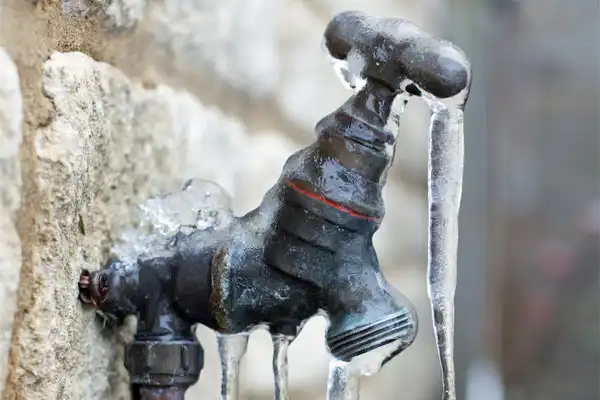
St. George gets a reputation for skipping winter. The golf courses stay open, the Snow Canyon trails stay busy, and while the rest of Utah is shoveling out, you’re wearing a light jacket in December. That reputation is exactly why outdoor plumbing tends to get damaged here.
Washington County nights do drop below freezing, usually a handful of times between late November and February. It doesn’t take a Cache Valley winter to split a hose bib. It takes one cold night and a garden hose somebody forgot to disconnect. Any Hour Services has been helping homeowners for over 60 years, and burst pipe repairs stays on our St. George service list for a reason.
Here’s the short version of what to handle, and when.
What Should You Do With Hose Bibs and Outdoor Faucets?
When it comes to winterizing your outdoor plumbing, start here. Outdoor faucets are the single most common freeze failure point on a home, and the fix takes about 10 minutes.
- Disconnect All Garden Hoses: A connected hose traps water against the faucet and inside the spigot, which is exactly where a freeze does damage. This one step prevents more outdoor plumbing problems than anything else on this list.
- Drain & Store Hoses: Stretch each one out, let the water run out, then coil and store it somewhere sheltered. Water left inside a hose will freeze, expand, and shorten the lifespan of the hose too.
- Shut off the Indoor Valve If You Have One: Many homes have a dedicated shutoff inside the home for each outdoor faucet, often in a basement, garage, or crawlspace. Close it, then open the outdoor faucet to let the remaining water drain out. Leave the outdoor faucet open through winter.
- Add Insulated Faucet Covers: Foam or hard-shell covers cost very little and slip right over a spigot. For an exposed faucet on a north-facing wall, this is worth doing every single year.
- Look for a Frost-Free Replacement: Frost-free hose bibs shut the water off farther back inside the wall, where it stays warmer. If yours has already frozen once, replacing it is a permanent fix rather than an annual worry.
Finally, if a faucet drips after you shut it off, or if the handle turns without doing much, the valve is already worn out. This is a repair or replacement worth handling before the first freeze rather than after.
How Do You Winterize Sprinklers and Irrigation Lines?
Irrigation lines sit shallow, hold water, and run all over the yard. In our area, this is the second place freeze damage tends to show up. The pieces that need attention:
- Shut Off the Irrigation Water Supply: Find the main valve for the irrigation system and close it so no new water enters the lines.
- Clear the Water Out of the Lines: Some irrigation and sprinkler systems drain by gravity through manual drain valves. Others need to be blown out with compressed air, which is the standard approach for most sprinkler systems. If you’re not sure which kind you have, that’s a fair question to ask before guessing. Just call Any Hour and one of our expert plumbers would be happy to help you out.
- Protect the Backflow Preventer: This device sits above ground and is one of the more expensive parts of an irrigation system to replace. Drain it and insulate it.
- Shut Down the Timer: Set the controller to off or rain mode so the system doesn’t try to run on a freezing morning.
While Any Hour can handle the plumbing inside and outside your house, irrigation and sprinkler systems typically require specialty equipment. This is best handled by an irrigation specialist. But don’t sweat it – our team is happy to help connect you to someone you can trust. What we can help with directly is everything from the shutoff valve inward, including the water line that feeds the system.
What Else Around the Outside of the House Needs Attention?
When it comes to outdoor plumbing, a few items typically get overlooked. Each one of these is much cheaper to handle now than in January.
- What about the water heater in an unheated garage? Water heaters in a garage or on an exterior wall work much harder in cold weather and are significantly more exposed. Scheduling your annual water heater maintenance before the winter will flush out any sediment and ensure the system is running correctly while you still have a choice about timing.
- Do outdoor drains matter in the winter? Absolutely. A drain that’s already slow will almost certainly handle winter runoff poorly, and standing water near the foundation is a major problem when temperatures start to swing. Booking a drain clearing service beforehand will keep water moving away from your house.
- Should you worry about pipes in a crawlspace or exterior wall? Yes, especially in older St. George homes. Pipes running through unheated spaces or along exterior walls are the ones that freeze indoors. Adding pipe insulation is inexpensive, and sealing the gaps where cold air enters helps just as much.
- What if you’re leaving town for the winter? Shut off the main water supply, drain the system, and set the thermostat no lower than 55 degrees. Having someone check on the house periodically is also worth arranging, since an unnoticed leak in an empty home can produce an enormous amount of damage.
What Are the Warning Signs of a Frozen or Damaged Pipe?
Catching these warning signs early can change the outcome considerably. If you notice any of the following around your home, be sure to call Any Hour right away to address the issue:
- No Water From a Faucet On a Cold Morning: If one fixture stops working after a freezing night and the others are fine, you likely have ice in that line. Leave the faucet open and warm the area gently. And remember – never use an open flame.
- Reduced Pressure at an Outdoor Spigot: Weak water flow where it used to be strong can mean a partial blockage or a crack that’s diverting water.
- A Wet Spot or Unusual Sound: Water running when there are no fixtures running, damp drywall, or a warm patch on a floor all point to a leak. Any Hour’s expert slab leak detection can locate exactly where the leak is so as to not waste any more precious time.
- A Jump On Your Water Bill: A water bill that is climbing without any change in habits is often the first sign of a leak somewhere in your system.
- Visible Bulging or Frost On Pipes: Frost forming on a section of your pipes is a clear signal that something is very wrong, as well as any bulge or split you can see. Shut the water off at the main and call (435) 534-7436 before it thaws.
A frozen pipe that hasn’t burst yet is a situation that you can still control. Any Hour answers the phone with a live person seven days a week, and you can book online any time.
Handle It Now, Not After the First Hard Freeze
Go disconnect the hoses. Seriously, that alone prevents most of the problems that we get called about. Then work down the rest of the list over a weekend afternoon while the weather is still pleasant enough to enjoy being outside.
If something looks worn, drips, or you’ve had a freeze problem before, get it looked at while it’s still a small job. Our VIP Membership Plan keeps this kind of seasonal upkeep on a regular schedule, and financing is available for larger repairs. Lastly, current coupons are listed on our offers page for more savings.
Any Hour Services proudly serves St. George, Washington, Santa Clara, Ivins, Hurricane, La Verkin, Toquerville, Leeds, Springdale, Cedar City, Enoch, Parowan, Enterprise, Kanab, and communities throughout southwestern Utah. Call (435) 534-7436 or book online today to get started.