
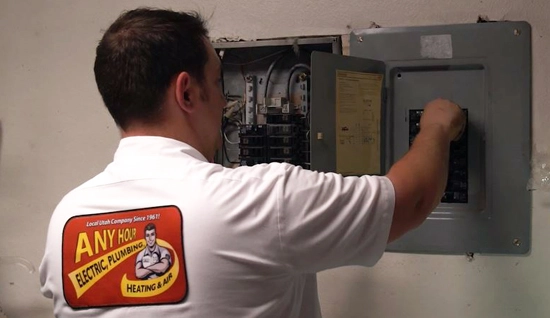
Electrical Load Safety During Heat Waves: What Phoenix Homeowners Should Know
There’s a specific moment every Phoenix summer where you start paying attention to your electrical panel. Usually it’s the third day of a 115-degree stretch, the AC has been running essentially without stopping, and then the breaker trips. You go flip it back on, the house starts cooling again, and you tell yourself it was a fluke. Until two days later it happens all over again.
Here’s the thing. That breaker isn’t exactly malfunctioning. It’s doing exactly what it was built to do, which is warn you that something in your electrical system is being pushed harder than it should be. And in a Valley summer, there are more reasons for that than most homeowners realize.
Any Hour Services has been helping homeowners since 1961, and our licensed electricians see this pattern every single summer across Phoenix, Mesa, Scottsdale, and the rest of the Valley. Here’s what’s actually happening in your home, what’s safe to ignore, and what genuinely isn’t.
Why Do Heat Waves Put So Much Strain on Home Electrical Systems?
During a Phoenix heat wave, your air conditioner runs nearly continuously instead of cycling on and off, and it’s by far the largest electrical load in most homes. Add pool equipment, refrigerators working harder, fans, and everything else running at once, and your circuits carry sustained demand far beyond what they handle the rest of the year.
But, there’s a second factor at hand here that gets almost no attention, and it matters a great deal.
- Does Extreme Heat Affect the Electrical System Itself? Absolutely. Circuit breakers are thermally calibrated, meaning they respond to heat. A panel mounted on a west-facing exterior wall in direct afternoon sun operates very differently than one sitting in a shaded garage. When ambient temperature climbs high enough, a breaker can trip at a lower load than it would on a mild day. Attic wiring faces the same issue. Attic temperatures climb well above outdoor air temperature during a heat wave, and that heat is hard on wire insulation and connections over time. So heat isn’t only increasing demand on your system, it’s also making the system itself less tolerant.
- Why Does My Breaker Trip in Summer But Never in Winter? Because both sides of the equation change at once. Your AC pulls far more sustained current in July than in January, and the breaker protecting that circuit is operating in much hotter conditions. Add a component that’s already worn, and summer is when it finally shows up. Repeated summer tripping is a signal worth investigating, not resetting.
- Do Pool Pumps Add Meaningful Load? They do, and Phoenix has a lot of pools! Pool and spa equipment represents a significant, sustained draw that runs right alongside your AC during the hottest part of the year. Pool and hot tub circuits also have specific safety requirements, which is one reason our electricians look closely at them during an inspection.
- Is My Older Phoenix Home More at Risk? Oftentimes, yes. Many homes across the Valley were wired decades ago for households that used far less power. No EV charger, no second refrigerator in the garage, smaller AC systems, fewer electronics. A panel that was generous in 1978 can be genuinely tight today, and summer is when that margin disappears.
None of this necessarily means your home is unsafe though. It just means summer is the season when weak points tend to reveal themselves. Knowing what to watch for is worth a few minutes.
What Warning Signs Should You Watch For?
You don’t need any tools or expertise to notice these. Walk through your home and pay attention to the following.
- A breaker that trips repeatedly, especially when the AC starts up.
- Warm or discolored outlets or switch plates, or a cover plate that’s hot to the touch.
- Lights that dim or flicker every time the compressor kicks on.
- A burning or hot-plastic smell near any outlets or the panel, which always warrants immediate professional attention from Any Hour.
- Buzzing or crackling sounds from the panel, an outlet, or switch.
- Outlets that no longer hold a plug snugly or have stopped working entirely.
- Electrical bills climbing faster than the weather explains.
- Extension cords doing permanent work, like powering a garage refrigerator or window unit.
That burning smell deserves extra emphasis. If you ever notice burning odors near your panel or any of your outlets, stop using that circuit and call (602) 362-9079 right away. This is not a wait-and-see situation and must be resolved immediately.
How Can You Reduce Electrical Load This Summer?
You can’t change the forecast, but you can meaningfully reduce how hard your home has to work to accommodate it. Here’s what actually helps.
- Maintain Your Air Conditioner: This is the highest-value item on the list. An AC system with dirty coils, low refrigerant, or a weakening capacitor draws more current just to do the same job. Keeping it healthy lowers your electrical demand directly. Any Hour’s A/C maintenance service carries a No Breakdown Guarantee.
- Add Ceiling Fans: Moving air lets most people stay comfortable at a higher thermostat setting, and a ceiling fan uses a tiny fraction of what your AC does. Raising your setpoint even slightly takes real load off the biggest draw in the house.
- Assess Your Panel Capacity: If you’ve added a pool, a second refrigerator, a workshop, or an EV charger to a home that was wired decades ago, your panel may be carrying more than it was designed for. That’s a conversation worth having before a heat wave rather than during one.
- Consider a Whole House Fan: QuietCool whole house fans pull cooler evening air through the home once outdoor temperatures drop, which lets your AC rest during the overnight hours instead of running straight through.
- Improve Your Insulation: Insulation is the quiet hero of load reduction in the greater Phoenix area. A better-insulated home holds cooler air longer, which means shorter AC run times and less sustained electrical demand.
- Look at Zoning: A home zoning system conditions the spaces you’re using rather than forcing one system to cool the entire house evenly, which reduces both runtime and strain.
- Shift Heavy Loads to Off-Peak Hours: Running the dishwasher, laundry, and pool pump outside the late-afternoon peak eases pressure on both your home and the grid, and depending on your utility plan it could reduce your energy bill as well.
- Plan Ahead for Outages: Losing power during a Phoenix heat wave is a genuine safety concern, not just an inconvenience. This is especially the case for older adults, young children, and anyone with medical equipment. A standby generator will keep the cooling running even when the grid doesn’t.
Get Ahead of the Next Heat Wave in Phoenix, AZ
Phoenix summers are going to do what Phoenix summers do. But, here’s the thing. Your electrical system doesn’t have to struggle through them, and it definitely shouldn’t be warning you repeatedly while you keep flipping the breaker back on.
Whether you’ve noticed a breaker tripping, a warm outlet, lights dimming when the AC kicks on, or you’d simply just like peace of mind before the next stretch of triple digits, our licensed electricians are ready to help.
Any Hour Services proudly serves Phoenix, Mesa, Scottsdale, Gilbert, Chandler, Glendale, Peoria, Tempe, Surprise, Goodyear, Paradise Valley, Sun City, and communities throughout the Valley. Call (602) 362-9079 today or schedule your electrical safety inspection online, seven days a week.